Samarkand: what to see in 1–2 days
Samarkand: the Registan and beyond
Gur-e Amir’s turquoise dome, Shah-i-Zinda’s mosaics and the Registan’s three madrasas are Samarkand’s best-known sights. Beyond them lies an older city, with Afrasiab’s Sogdian murals, craft traditions and a history of astronomical discovery.
Already in town? Choose a Samarkand tour with a local guide. From the capital, there are rail packages for a day trip or an overnight stay.
Updated:
Samarkand at a glance
Samarkand lies in the Zarafshan Valley. Walk between the central monuments and use a car for the observatory and craft workshops.
Leave time to return to the Registan in the evening: different light gives the square a different character.
Samarkand on your Uzbekistan route
Between Tashkent and Bukhara
Samarkand fits naturally between Tashkent and Bukhara. Trains connect it with both cities, while airport SKD receives direct international flights.
How much time do you need?
Allow a full day for the main monuments. Two days let you add Afrasiab, the observatory and Konigil. Set aside extra time for the countryside or a trip into Tajikistan.
Arriving at Samarkand Airport
Samarkand Airport, code SKD, is within the city. Take a taxi or a pre-booked car to your hotel. For accommodation in an old neighbourhood, check where a vehicle can reach the entrance.
Airport pick-up
Provide your flight number, date, number of guests, luggage details and full hotel address. After an international flight, allow time for passport control and baggage collection.
Arriving before check-in
For an early morning arrival, arrange luggage storage or early check-in. If arriving after midnight, check which night your booking covers.
When connecting from a flight to a train, allow time for passport control, baggage and the journey to the station. Keep your first day lighter after a late arrival.
On 27 August 2026, the airport welcomed the first Nordwind Airlines flight from Kazan. This adds another direct way to reach Samarkand; check travel dates and seats with the airline before booking. Airport announcement, in Russian.
Four experiences in Samarkand
Mosaics up close
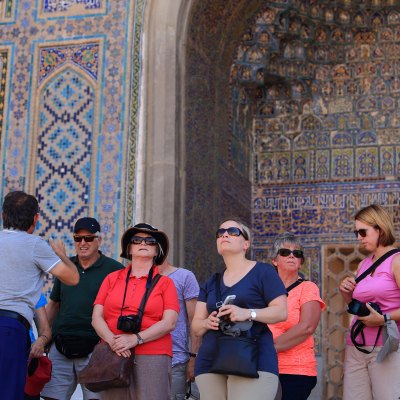
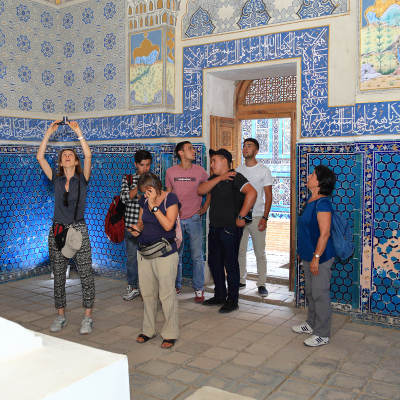
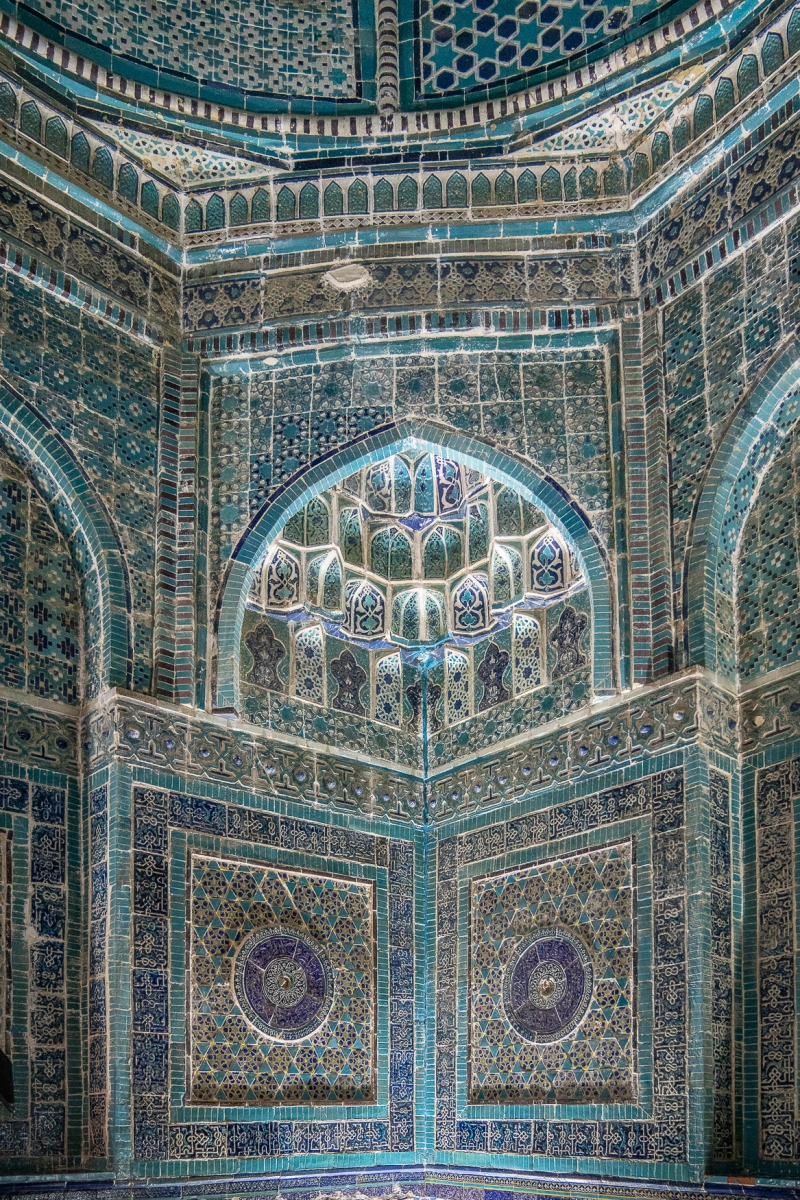
Look closely at the mausoleums’ tilework: tiny pieces form inscriptions, stars and floral patterns. Leave enough time to enjoy the details without rushing.
Traces of the ancient city
Afrasiab’s murals are more rewarding with a guide’s explanation. Clothing, embassies and ceremonial scenes help bring pre-Timurid Samarkand to life.
Beyond the grand squares
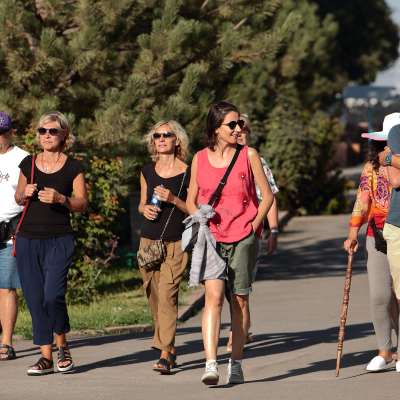
Turn off the main route towards bread shops and local teahouses. Pause for tea and see the everyday pace of Samarkand.
Crafts beside a waterwheel
Linger by the water after visiting a workshop in Konigil. It is a peaceful stop for anyone who enjoys balancing grand monuments with living craft traditions.
What to see in Samarkand
Alternate architecture with museum visits and craft stops. Our two-day itinerary works well for a first visit.
The main historic monuments
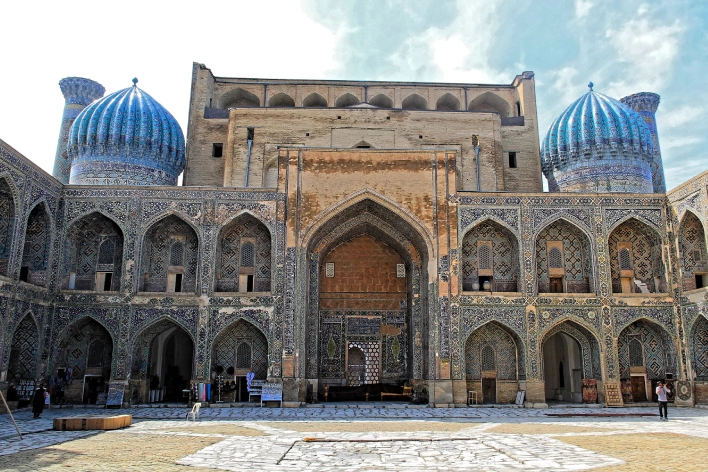
Registan Square
Ulugh Beg, Sher-Dor and Tilya-Kori madrasas frame the city’s main square. Allow at least an hour for the courtyards, façades and Tilya-Kori’s golden interior.
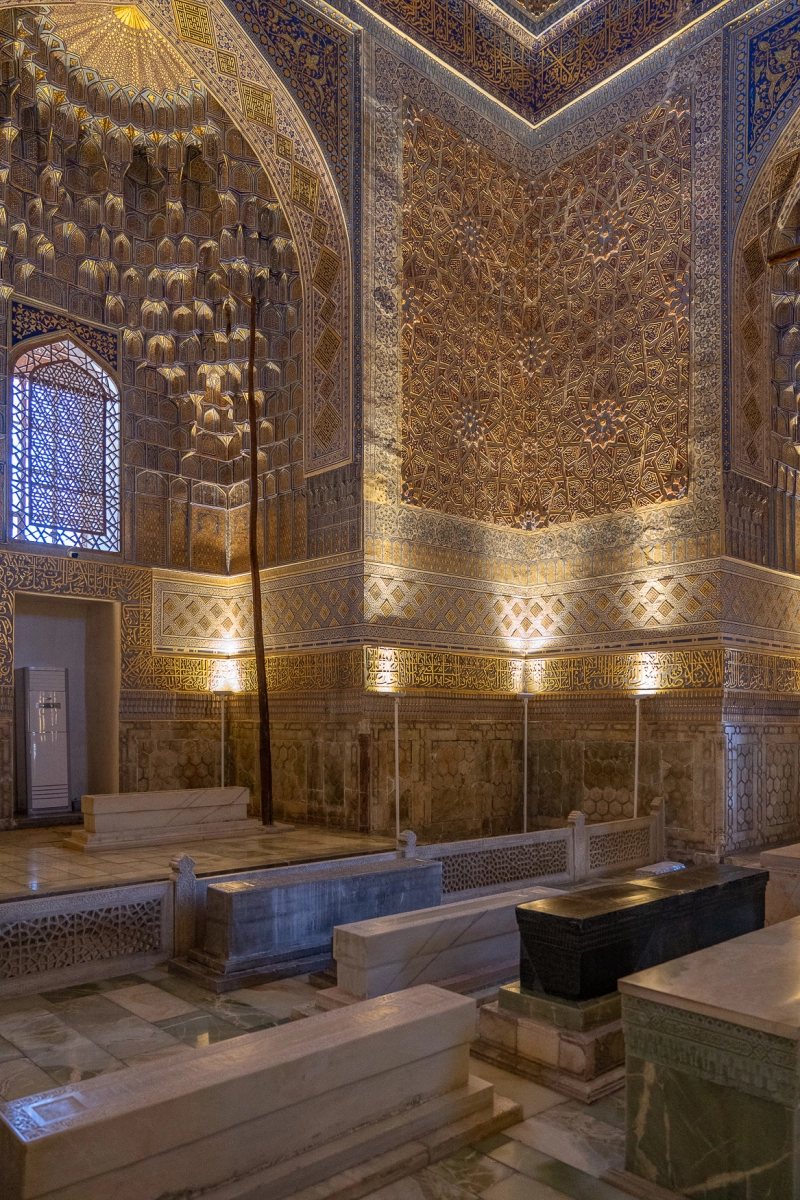
Gur-e Amir Mausoleum
The burial place of Amir Temur and his family introduces the dynasty’s history. Look at the ribbed dome, the building’s proportions and its interior decoration.
Bibi-Khanym and Siab Bazaar
The monumental mosque recalls Samarkand’s flourishing years under Amir Temur. Combine your visit with neighbouring Siab Bazaar.
Shah-i-Zinda ensemble
This lane of mausoleums climbs a hillside and brings together monuments from different periods. Each portal has its own glazes, inscriptions and decorative techniques.
Ancient history, science and crafts
Afrasiab Museum and ancient site
The museum preserves 7th-century Sogdian murals, while the archaeological site reveals the scale of ancient Samarkand. A guide helps make sense of the collection.
Ulugh Beg Observatory
Part of an enormous 15th-century astronomical instrument survives here. A small exhibition introduces Ulugh Beg and Samarkand’s scholars.
Hazrat Khizr and Khoja Daniyar
Hazrat Khizr offers views over the old town. Near Afrasiab, Khoja Daniyar’s mausoleum is associated with traditions shared by several religions; it is easiest to visit by car as a separate stop.
Konigil paper workshop
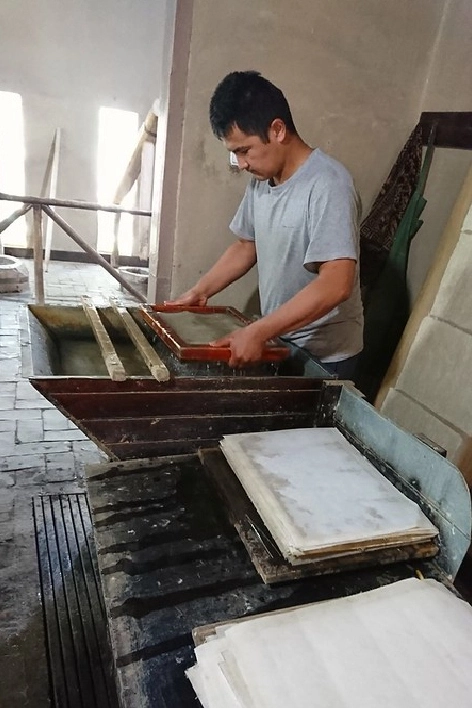
Watch paper being made from mulberry bark in Konigil. Arrange a demonstration time in advance and plan to travel from the centre by car.
Abu Mansur al-Maturidi Mausoleum
The mausoleum of Abu Mansur al-Maturidi commemorates a theologian associated with Samarkand. Consider it as an optional stop on a religious heritage route; confirm access and visiting times beforehand.
Silk carpets at Khujum
Khujum preserves the craft of weaving silk carpets by hand. To see the artisans at work, arrange your visit and confirm available demonstrations beforehand.
Samarkand in one or two days
One day: the main monuments
- Gur-e Amir.
- Registan: madrasas and courtyards.
- Bibi-Khanym → Siab Bazaar.
- Lunch and a rest.
- Shah-i-Zinda.
- Hazrat Khizr or Ulugh Beg Observatory, if time allows.
Start in the morning and use short drives between stops. Choose the interiors that interest you most and add the observatory only if you have enough time.
Two days: the city and Konigil
Day one: Gur-e Amir → Registan → lunch → Bibi-Khanym and Siab Bazaar. Leave the evening free for your own walk.
Day two: Shah-i-Zinda → Hazrat Khizr → Afrasiab Museum and Ulugh Beg Observatory → lunch → Konigil. You can visit Khoja Daniyar instead of one museum stop.
Starting in the capital? The two-day Samarkand tour from Tashkent combines travel, an overnight stay and sightseeing. The first day’s timing depends on your confirmed train.
Map and city distances
Where to walk
Registan, Bibi-Khanym and Siab Bazaar make a convenient walking route. You can continue to Shah-i-Zinda if the weather suits and you have energy for the steps inside.
Where a car helps
Use a car for Afrasiab, the observatory and Konigil. Save the stops on a map and agree where to meet your driver afterwards, especially at monuments with several exits.
Before you set out
Seasons and heat
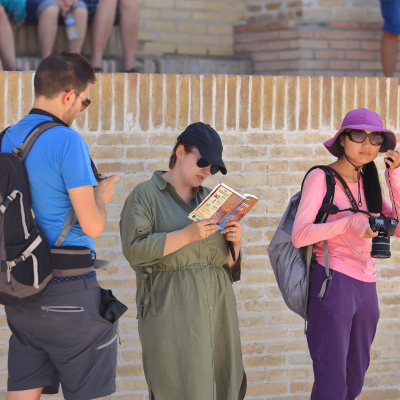
Spring and autumn suit longer walks. In summer, start early, take a midday break and carry water; in winter, plan around shorter daylight hours.
Visiting times
Museum hours and access to individual courtyards can change during events or restoration. For an evening at the Registan, check admission hours and ticket conditions for your chosen date.
Steps and clothing
Shah-i-Zinda has many steps. Wear comfortable shoes and cover shoulders and knees at active religious sites. Discuss any walking limitations when choosing your route.
Money and internet
Carry cash in Uzbek sums for the bazaar. Check payment methods at hotels and restaurants before ordering. Download a map and save the agreed meeting point and your driver’s contacts for offline use.
Tour and excursion prices
Prices in US dollars, checked on 12 September 2026. Compare the starting point, number of travellers and accommodation category.
Samarkand city tour
$125 for one guest; $79 per person for two; $69 per person for 3–6 guests. Includes a local guide, transport and admission tickets. Lunch costs extra.
One day from Tashkent
$209–680 for a group of 1–7 travellers; $284 total for two. Includes trains, sightseeing, local transport, admission tickets and lunch, with no overnight stay.
Two days from Tashkent
From $375 per person sharing a double or twin room in the Standard category, for a booking of at least two guests. Includes trains, one night with breakfast, sightseeing, local transport, admission tickets, two lunches and dinner as listed in the programme.
Shakhrisabz in one day
$170 for one guest; $100 per person for two; from $65 per person for 3–6 guests. Includes a return car from Samarkand, a guide in Shakhrisabz and admission tickets. Lunch costs extra.
Find full itineraries in the tour section. Train and hotel availability are checked for your dates. Agree your guide language and any supplements before payment.
Where to stay in Samarkand
Near the Registan
Convenient for evening walks and an early start at the main monuments. Ask about street noise and vehicle access when arriving with luggage.
Siab and the old neighbourhoods
Small hotels and guesthouses suit travellers interested in local residential streets. Compare exact locations, stairs and room sizes.
The modern centre
Larger hotels and easy vehicle access can suit groups. For an early train, compare travel time to the station as well as to the monuments.
Silk Road Samarkand
This resort and congress complex is outside the historic centre. It suits events and stays focused on its facilities; you will need transport to the Registan.
What to eat in Samarkand
Samarkand plov
Rice, carrots and meat are often served in layers in Samarkand plov. Try it at lunchtime, when plov restaurants prepare their main batches.
Samarkand bread
Samarkand’s round bread is dense and aromatic. Share a fresh loaf at the table; for travel, avoid wrapping it tightly while it is still hot.
Shashlik, manty and lagman
Grilled meat, steamed dumplings and noodles make a satisfying dinner after sightseeing. Ask about fillings, broth and sauces if you avoid certain foods.
Tea, dried fruit and sweets
Tea with local sweets makes an easy break between visits. Check portion sizes and any service charge on the menu beforehand.
Trains and onward travel
From Tashkent to Samarkand
Compare high-speed and conventional trains from the capital. Check departures, journey times and seats for your travel date; the confirmed ticket will name your departure station. Read about the booking options on our Uzbekistan train ticket page.
From Bukhara and to other cities
Trains connect Samarkand with Bukhara, while a car allows stops along the way. Agree the full sequence of cities before arranging train tickets.
Transfers and the border
Stations, airports and regional trips
Book a pick-up or a car with stops en route to Bukhara or Shakhrisabz. Provide guest numbers, suitcase sizes and your final address. The mountain-pass route depends on the weather and vehicle type.
If your flight or train changes, send the updated details to CAJ.UZ and reconfirm the pick-up time.
Jartepa–Sarazm
Jartepa / Sarazm is the crossing for travel towards Panjakent. For a day trip, consider the Panjakent and Sarazm tour from Samarkand. Confirm your right to enter Tajikistan and return to Uzbekistan, crossing operations and driver meetings before departure. See border crossings with Tajikistan.
Crafts and shopping
What to buy at Siab Bazaar
Try dried fruit, nuts, spices and sweets before buying small portions. Check the price by weight and ask for packaging suitable for travel.
Paper, embroidery and Urgut
Konigil offers handmade paper. For textiles and embroidery, consider Urgut too: allow half a day or a day by car for its bazaar and Chor-Chinor, checking the best market day beforehand.
For antiques, check customs rules and export documents before buying. Ask permission before photographing craftspeople or sellers.
Day trips from Samarkand
Imam Bukhari complex
The memorial complex outside the city is dedicated to Imam Bukhari and his legacy. Allow half a day with a car for a separate visit. Confirm which areas are open and the visiting times for your date; avoid adding this outing to an already full day of city sightseeing.
Shakhrisabz
Ak-Saray, Dorus-Saodat and Dorut-Tilovat add to the story of the Timurid era. Allow a full day for a Shakhrisabz excursion from Samarkand. The Takhtakaracha Pass is used only in suitable conditions; larger vehicles take the alternative route.
Zarafshan National Park
Riverside tugai woodland appeals to nature lovers and birdwatchers. Set aside a separate morning or half-day including transport. Arrange access and your route with the administration; wildlife sightings are not guaranteed. Explore other natural parks in Uzbekistan too.
Seven Lakes and Iskanderkul
These mountain trips cross into Tajikistan. A Seven Lakes day trip from Samarkand means an early departure and late return. To visit both areas, choose Seven Lakes and Iskanderkul in two days with an overnight stay. Road conditions and border formalities affect the programme.
Tours in and to Samarkand
Choose by your starting point and available time. City tours and trips from the capital differ in travel arrangements, accommodation and meeting point.
The city with a local guide
For guests already staying in Samarkand. A guide introduces the main monuments and a car connects the more distant stops.
From Tashkent without an overnight stay
A short visit between morning and evening trains. Suitable if you have just one free day.
From Tashkent with a hotel stay
Stay in the city for the evening and continue exploring the next day. The programme includes ancient Samarkand and a craft stop.
A day out in Shakhrisabz
Discover Amir Temur’s birthplace after Samarkand. The guide joins you in Shakhrisabz, while the driver handles the road journey.
Traveller reviews
What our guests say
Guests share their experiences of guides, journeys and travel arrangements. Look for details that matter to travellers following a route like yours.
A programme for your interests
Archaeology, religious history, crafts or photography: tell us what interests you most. We will choose stops and visiting times accordingly.
Samarkand with CAJ.UZ
Experience since 1996
Central Asia Journeys is a local tour operator in Uzbekistan. Licence T-0292-14 and registration certificate No. 000346-07 are available on the company page.
Your whole trip arranged
We coordinate your train, hotel, guide language and local transport in one itinerary. After confirmation, you receive meeting times and contacts. Read our booking conditions and cancellation policy before ordering.
Tours that include Samarkand
Eight-day classic route
Tashkent, Samarkand, Bukhara and Khiva: the main cities for a first journey through Uzbekistan.
Three cities in seven days
Tashkent, Bukhara and Samarkand with organised transport and sightseeing, for a week in Uzbekistan.
Eight-day budget trip
Khiva, Bukhara, Shakhrisabz, Samarkand and Tashkent. Compare included services and expenses payable separately with the other programmes.
Aydarkul and yurts in twelve days
A longer route through historic cities, Nurata and a yurt camp near Aydarkul. Separate days are set aside for the desert and lake.
Samarkand travel questions
Can I re-enter the Registan with the same ticket?
Ask at the ticket office about re-entry before leaving. An evening visit may require a separate ticket.
Can I enter every building on the square?
Access depends on which exhibitions and rooms are open. Ask which courtyards and interiors your ticket covers on the day.
Do I need a ticket to photograph the Registan from outside?
You can photograph the ensemble from accessible public areas outside. Entry to the madrasas and designated areas is regulated separately.
Is Afrasiab suitable for children?
A short explanation of the murals and ancient city makes the museum easier to enjoy. Choose a longer walk across the exposed archaeological site according to your child’s age and the weather.
Can I buy something at the paper workshop?
Visitors are usually offered paper and small handmade items. Check the availability of specific pieces and hands-on sessions before visiting.
Do I need my passport for the train?
Bring the identity document used to book the ticket. Passenger details must match it; check them as soon as you receive your ticket.
Can the tour start at the station?
Yes, if a station meeting and transfer are included in your programme or booked separately. Provide your train number and luggage details.
How can I combine Panjakent and the Seven Lakes?
A two-day route from Samarkand via Panjakent works well for the city, Sarazm and the mountain lakes. It includes an overnight stay and dedicated time in the mountains.
Is there a separate trip just to Iskanderkul?
Yes, there is an Iskanderkul day tour from Samarkand. It is a long day with road travel and border formalities; compare it with the two-day option before choosing.
Can the tour be adapted for someone with limited mobility?
Yes, with advance planning. Tell us your comfortable walking distance and ability to manage steps so we can choose suitable stops and vehicle access points.
What if Afrosiyob is sold out?
Check other trains for the same date first. If none fits, agree on a car transfer and adjust your sightseeing time. For a day trip from Tashkent, avoid committing to non-refundable arrangements that depend on a train you have not secured.